
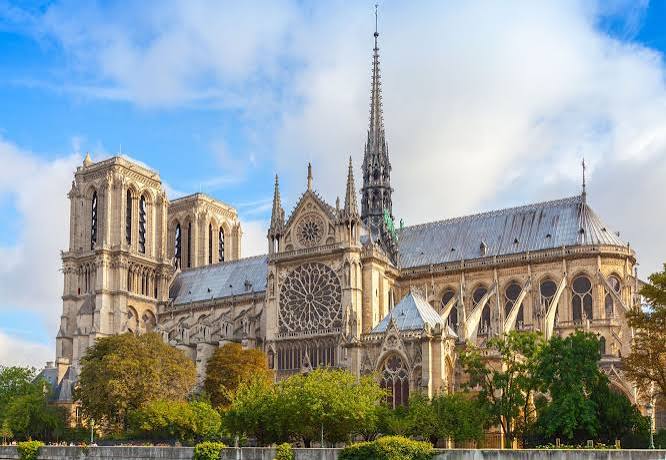
Gothic architecture emerged in the 12th century in France and spread across Europe, shaping the High and Late Middle Ages. Bold design and advanced engineering defined this style, which left a lasting mark on cathedrals, castles, churches, and universities. Its influence still resonates with architects and historians today. Early builders referred to the style as Opus Francigenum—“French work”—to honor its origins. However, Renaissance critics later mocked it as “Gothic,” linking it to barbarian tribes blamed for destroying classical ideals. Yet over time, the style evolved, won admiration, and earned lasting recognition for its beauty and complexity. As the style spread, it adapted to local cultures and materials. Cathedrals like Notre-Dame in Paris and Chartres reveal regional character and masterful design. Gothic architecture captured the spirit of its age, rooted in faith, rich in artistry, and reaching toward a new era.
Key Characteristics of Gothic Architecture:
1. Pointed Arches
Pointed arches provide greater flexibility compared to the round arches of Romanesque architecture, permitting the creation of taller and more slender structures. This design innovation broadens architectural possibilities and elevates the overall aesthetic.
2. Ribbed Vaults
A defining feature of Gothic architecture, ribbed vaults are formed by intersecting barrel vaults with rib-like stone frameworks. These ribs are essential for distributing the weight of the structure.
3. Flying Buttresses
These external supports, often referred to as flying buttresses, play a crucial role in structural engineering by transferring the weight of the walls and roof away from the building. By redirecting this weight down to the ground, they provide the necessary stability, allowing for the construction of thinner, more delicate walls. This innovation not only reduces the overall mass of the structure, but it also creates the opportunity to fill these slender walls with stunning stained glass. The large, colorful panels of glass, integrated into the design, allow natural light to filter through, enhancing the interior atmosphere and inspiring with their intricate artistic designs.
4. Large Stained-Glass Windows
Renowned for their striking rose windows, these expansive stained-glass installations are masterpieces that not only enhance the architectural beauty of the space but also permeate the interiors with a captivating display of colored light. The intricate designs within the glass depict various spiritual themes and narratives, allowing sunlight to filter through in a dazzling array of hues. This illumination creates a serene and ethereal atmosphere, transforming the interiors into a vibrant sanctuary that invites contemplation and awe.
5. Ornate Decorations and Sculptures
Gothic architecture is characterized by a variety of intricate features, with one of the most notable being gargoyles. These remarkable sculptures serve a dual purpose: they act as drain spouts, directing rainwater away from the building’s walls to prevent erosion, while also symbolizing creatures that ward off evil spirits. Additionally, Gothic buildings are often adorned with elaborate biblical scenes and figures, which are depicted in stained glass windows or carved stone reliefs. These artistic elements not only enhance the visual richness of the structures but also convey religious narratives and moral lessons to those who encounter them. The combination of functional and symbolic artistry in Gothic architecture creates a profound and captivating experience for viewers, deepening their appreciation of its artistic value.
6. Vertical Emphasis
Gothic architecture, with its distinctive tall spires, elegant towers, and soaring pinnacles, evokes a sense of reaching toward the heavens. This architectural style is renowned for its impressive verticality, creating structures that seem to stretch infinitely upward. Characterized by intricate stonework and vibrant stained glass windows, Gothic buildings often feature pointed arches and ribbed vaults, which contribute to their majestic appearance. The overall design not only captures the eye but also inspires a feeling of awe, reflecting the spirituality and grandeur of the era in which it flourished.
7. Intricate Tracery
The decorative stone frameworks serve as a robust support system for the exquisite stained glass, enhancing the artistic composition with intricate detailing. These frameworks not only provide structural integrity but also contribute significantly to the aesthetic appeal, featuring elaborate carvings and designs that complement the vibrant colors and patterns of the glass. The interplay between the sturdy stone and the delicate glass creates a captivating visual experience, inviting viewers to appreciate the craftsmanship and creativity involved in the overall design.
Famous Examples of Gothic Architecture
Name
- Notre-Dame de Paris
- Chartres Cathedral
- Milan Cathedral (Duomo)
- Cologne Cathedral
- Westminster Abbey
Location
- Paris, France
- Chartres, France
- Milan, Italy
- Cologne, Germany
- London, England
Notes
- Known for its iconic façade and rose windows
- Masterpiece of early Gothic architecture
- Largest Gothic cathedral in the world
- Monumental twin spires
- Coronation church of British monarchs
Why Gothic Style is Important
Gothic architecture was more than just a method of construction; it was a profound expression of medieval spirituality, authority, and artistic vision. These grand structures, characterized by their towering ceilings and expansive stained glass windows, were meticulously designed to immerse visitors in a radiant glow. This design evoked a sense of wonder and fostered an intimate connection to the divine.
This architectural style marks a significant turning point in the evolution of building techniques, where the principles of form and function came together in exquisite harmony. The soaring arches and intricate details not only served practical purposes but also created an ethereal atmosphere that stirred the soul and uplifted the spirit.
Gothic Architecture Timeline
| Period | Years (approx.) | Key Features | Example |
|---|---|---|---|
| Early Gothic | 1130–1200 | Heavy, solid forms, experimental pointed arches | Abbey Church of Saint-Denis |
| High Gothic | 1200–1280 | Height, stained glass mastery, flying buttresses | Chartres Cathedral |
| Rayonnant Gothic | 1240–1350 | Focus on window tracery, slender supports | Sainte-Chapelle, Paris |
| Flamboyant Gothic | 1350–1550 | Flame-like, ornate stonework | Rouen Cathedral façade |
| Perpendicular Gothic (England) | 1350–1550 | Strong vertical lines, fan vaults | King’s College Chapel, Cambridge |
Comparative Chart: Gothic vs Romanesque vs Baroque
| Feature | Romanesque (1000–1150) | Gothic (1130–1550) | Baroque (1600–1750) |
|---|---|---|---|
| Arches | Rounded | Pointed | Curved, dramatic |
| Vaulting | Barrel vaults | Ribbed vaults | Oval domes, illusionistic ceilings |
| Buttresses | Thick walls, small windows | Flying buttresses | Not emphasized |
| Light | Dim, small windows | Large stained-glass windows | Bright interiors with artificial light |
| Decoration | Modest, geometric carvings | Ornate, sculptural façades | Extravagant, gilded, theatrical |
| Emphasis | Solidity, earthbound | Verticality, heaven-reaching | Movement, emotion, grandeur |
| Famous Example | Speyer Cathedral | Notre-Dame de Paris | St. Peter’s Basilica, Vatican |
Notre-Dame de Paris
Historical Context
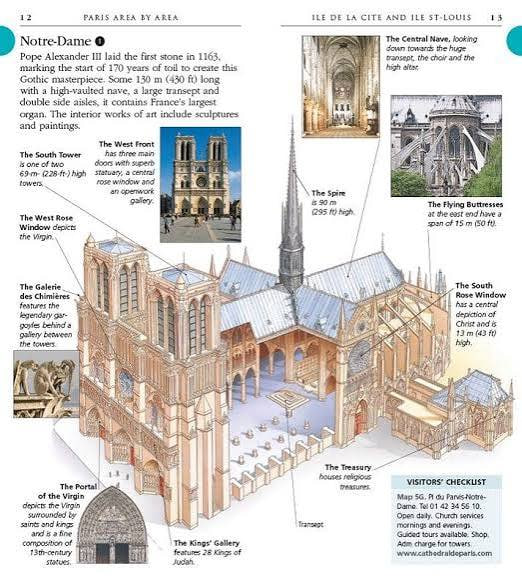
Notre-Dame was commissioned by Bishop Maurice de Sully in 1160 and began construction in 1163 on the Île de la Cité, right at the heart of medieval Paris. It took nearly two centuries to complete, reflecting the evolving Gothic style across generations of architects and artisans. Notre-Dame is central to Victor Hugo’s 1831 novel “The Hunchback of Notre-Dame” (Notre-Dame de Paris), which actually helped to save the cathedral from neglect and spurred the 19th-century Gothic Revival movement.
Exterior
Twin Towers: 69m tall, square-shaped, defining the western façade.
Rose Windows: Three monumental stained-glass rose windows (west, north, and south), among the greatest achievements of medieval glasswork.
Pointed Arches: Used in portals, windows, and interior vaulting.
Flying Buttresses: First major building to use flying buttresses on a grand scale — originally added to address structural issues.
Gargoyles: Both decorative and functional as rain spouts, often grotesque or animalistic.
Sculptural Façade: Biblical figures, saints, and the famous Gallery of Kings, a row of 28 statues of the Kings of Judah.
Interior
Nave: 130 meters long, 35 meters high.
Ribbed Vaults: Interlocking, crisscrossing ribs supporting the ceiling.
Massive Piers and Columns: Supporting the high vaults.
Stained-Glass Windows: Bathe the interior in mystical colored light.
Organ: One of the most famous pipe organs in the world, with five keyboards and nearly 8,000 pipes.
Hidden Design Details & Symbolism in Notre-Dame de Paris:
This building like all true Gothic cathedrals, was designed as a visual catechism — a literal Bible in stone and glass — conveying biblical stories, moral lessons, and the metaphysical relationship between the earthly and the divine through symbolic architecture.
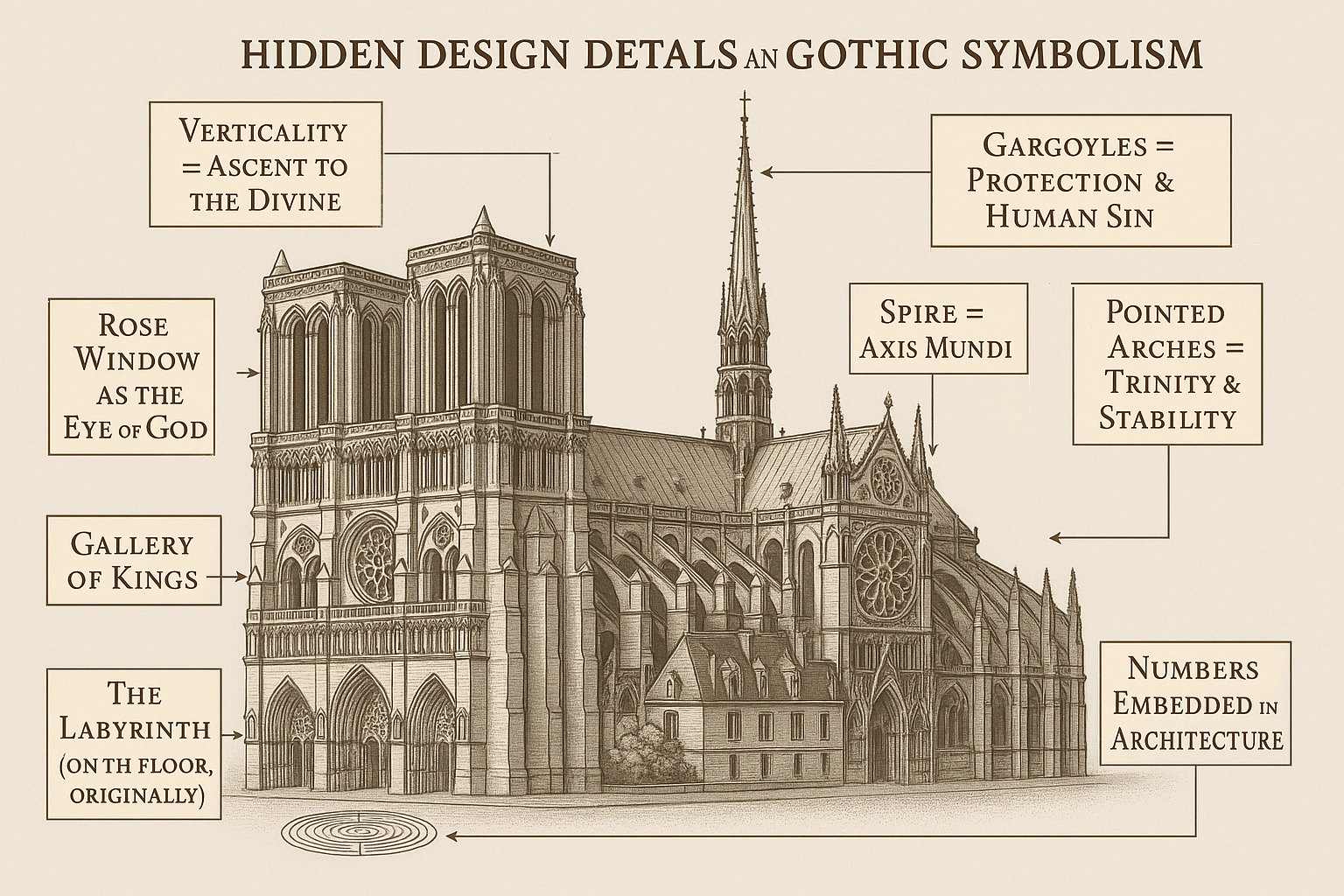
- Verticality = Ascent to the Divine
The dramatic upward thrust of the cathedral — from its spires, towers, and pointed arches — is a physical metaphor for reaching toward God. The height isn’t merely structural; it’s spiritual, guiding eyes and thoughts heavenward.
- Rose Windows as the Eye of God
Notre-Dame’s massive stained-glass rose windows (especially the West Rose) represent the eternal nature of God and the cosmos.
- The circular form = eternity, without beginning or end.
- The radial symmetry = divine order and harmony.
- The light passing through colored glass = divine illumination entering the human soul.
- The Labyrinth (on the floor, originally)
A now-destroyed labyrinth pattern once adorned the floor of Notre-Dame’s nave. Pilgrims followed its winding path as a symbolic journey toward salvation and enlightenment, representing life’s difficult, indirect path to God.
- The Gargoyles = Protection & Human Sin
Gargoyles aren’t just rain spouts — they symbolize:
- Protection: Scaring away evil spirits.
- Sinful humanity: Their grotesque forms reflect human vices and the baser aspects of existence, lurking on the edges of sacred space.
Gargoyles also served to remind the faithful that evil is ever-present outside, but cannot enter the holy sanctuary.
- The Gallery of Kings
Above the three west portals is a row of 28 statues representing the Kings of Judah, ancestors of Christ. During the French Revolution, these statues were decapitated by revolutionaries who thought they depicted the hated kings of France — only to be rediscovered buried nearby in the 1970s.
The 28 number itself is symbolic:
- 28 = 4 weeks × 7 days, relating to lunar months and the divine ordering of time.
- Pointed Arches = Trinity & Stability
The pointed Gothic arch has three main symbolic meanings:
- The Holy Trinity in its three-part form.
- A spiritual arrow, pointing to heaven.
- Structural perfection, distributing weight efficiently — a metaphor for divine wisdom in design.
- The Spire (before 2019) = Axis Mundi
The central spire, added in the 19th century by Viollet-le-Duc, acted as an axis mundi — the cosmic axis connecting heaven and earth, marking the center of sacred space both symbolically and geographically within Paris.
- Numbers Embedded in Architecture
Medieval architects embedded numerology into Notre-Dame’s dimensions:
- The numbers 3 (Trinity), 7 (spiritual perfection), and 12 (apostles, tribes of Israel) appear repeatedly in the number of columns, windows, bays, and vault ribs.
Final Thought
Gothic architecture, which flourished in Europe from the 12th to the 16th centuries, is a style defined by its dramatic verticality, intricate ornamentation, and deep spiritual symbolism. It emerged from Romanesque architecture and was revolutionary in its use of pointed arches, ribbed vaults, and flying buttresses—innovations that allowed buildings to soar higher and be filled with light through massive stained-glass windows. Structures like cathedrals were designed not just for worship but as visual expressions of divine order, with features such as rose windows symbolizing the eternity and light of God, and detailed sculptures and carvings teaching biblical stories to the largely illiterate population. Gothic buildings often incorporated symbolic numerology, sacred geometry, and metaphors for salvation, spiritual ascent, and the struggle between good and evil. Far from being just architectural feats, Gothic cathedrals were immersive, sacred environments intended to elevate the soul and reflect the glory of heaven on earth.
Frequently asked questions ( FAQs)
Gothic architecture introduced pointed arches, ribbed vaults, and flying buttresses, which allowed buildings to be taller and filled with light. Unlike the heavier, darker Romanesque style, Gothic structures emphasized verticality, openness, and rich ornamentation.
Stained-glass windows were both decorative and symbolic. They filled interiors with colorful light to create a heavenly atmosphere and told biblical stories through images, educating a largely illiterate population while reinforcing spiritual themes.
Yes. Gothic cathedrals were designed as spiritual metaphors. Elements like rose windows, sacred geometry, and sculptural narratives symbolized divine order, the path to salvation, and the eternal struggle between ood and evil.
No responses yet