
In lighting design, lux and lumens are two essential units used to measure the amount and intensity of light. Lumens (lm) indicate the total amount of visible light emitted by a source, while lux (lx) measures how much of that light actually illuminates a surface area. Understanding the relationship between these two is crucial for architects, interior designers, and anyone working with lighting, as it directly impacts the ambiance, visibility, and energy efficiency of a space. Simply put, 1 lux = 1 lumen per square meter — meaning lux considers both the light output and how it spreads over an area.
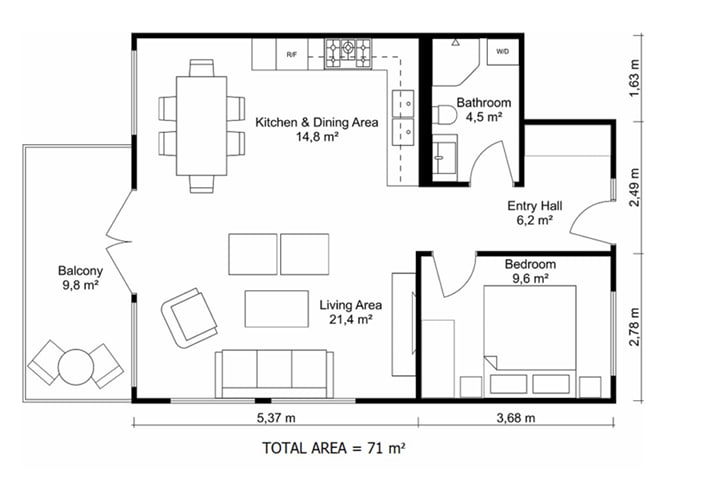
Let’s say you’ve been given the following floor plan and need to determine the appropriate lighting for each space. To do this, you must calculate the required lumens based on the target lux level for that room type and the area shown on the plan.
Bedroom
For General Lighting:
General bedroom lighting: 100–150 lux
- At 100 lux: 100×10.23=1023 lumens
- At 150 lux (for a brighter option): 150×10.23=1535 lumens
For Reading Corner or Task Lighting:
Reading or task lighting: 300–500 lux (for bedside or desk areas)
- At 300 lux: 300×task area size (m²)
If it’s a 1m² bedside table area: 300×1=300 lumens (per lamp)
- At 500 lux: 500×1= 500 lumens
Final Summary:
| Purpose | Lux Level | Total Lumens Needed |
| General Bedroom Lighting | 100–150 lux | 1023–1535 lumens |
| Reading/Task Area | 300–500 lux | 300–500 lumens (per lamp) |
- 1 ceiling light of 1200 lumens (LED bulb around 12–14W)
- 2 bedside lamps of 400 lumens each for reading (5W LED)
This would comfortably light bedroom for both general use and task lighting.
Now, can you figure out the required lumens for the bedroom based on the floor plan?
Bathroom
For General Lighting:
General bathroom lighting: 200–300 lux
- At 200 lux: 200×4.5=900 lumens
- At 300 lux: 300×4.5=1350 lumens
For Task Lighting:
Task lighting (mirror, shaving, makeup area): 500–1000 lux. For example, if mirror/task area is about 1 m²:
- At 500 lux: 500×1=500lumens
- At 1000 lux: 1000×1=1000lumens
Final Summary:
| Purpose | Lux Level | Total Lumens Needed |
| General Bathroom Lighting | 200–300 lux | 900–1350 lumens |
| Mirror/Task Area | 500–1000 lux | 500–1000 lumens (per mirror area) |
- 1 ceiling LED light of 1200 lumens (12–14W LED)
- 2 wall lights beside the mirror at 400 lumens each
(or 1 strip light above mirror at 800 lumens)
This setup gives you bright, even lighting for both showering and grooming tasks, while avoiding harsh shadows around the face.
Now, can you figure out the required lumens for the bathroom based on the floor plan?
Entry Hall
Entry/Hallway lighting: 100–200 lux ( It should feel welcoming but not overly bright. )
- At 100 lux: 100×6.2=620 lumens
- At 200 lux: 200×6.2=1240 lumens
Suggestion:
1 ceiling fixture of 1000 lumens (around 10–12W LED)
Optionally, add small wall sconces or accent lighting (300–400 lumens each) for a warmer, layered look — especially if you have artwork, a mirror, or a coat hook area you’d like to highlight.
Now, can you figure out the required lumens for the entry hall based on the floor plan?
Living Room
- General ambient lighting: 100–300 lux
(100 lux for cozy mood lighting, 200–300 lux for a brighter, more functional space) - Task lighting (like reading corners or workspaces): 300–500 lux
- Accent lighting (for décor, shelves, or art): 150–200 lux on those areas
For General Lighting:
- At 100 lux: 100×21.4= 2140 lumens
- At 200 lux: 200×21.4=4280 lumens
- At 300 lux: 300×21.4=6420 lumens
Final Summary:
| Purpose | Lux Level | Total Lumens Needed |
| General Living Room Lighting | 100–300 lux | 2140–6420 lumens |
| Task Lighting (per task area) | 300–500 lux | 300–500 lumens (per lamp/area) |
| Accent Lighting (per feature) | 150–200 lux | 150–300 lumens (per light) |
Lighting Example:
- General lighting:
- 3–4 ceiling downlights at 1000–1200 lumens each
or - 1 central fixture at 2500–3000 lumens plus wall sconces
- 3–4 ceiling downlights at 1000–1200 lumens each
- Task lighting:
- 1–2 floor or table lamps at 400–800 lumens for reading corners or workspaces
- 1–2 floor or table lamps at 400–800 lumens for reading corners or workspaces
- Accent lighting:
- LED strip or spotlights at 200–300 lumens for shelves, art, or decorative elements
- LED strip or spotlights at 200–300 lumens for shelves, art, or decorative elements
Now, can you figure out the required lumens for the living room based on the floor plan?
Kitchen & Dining Area Size:
- General kitchen lighting: 300–500 lux
- Worktop/task lighting (over counters, stove, sink): 500–750 lux
- Dining area lighting: 200–300 lux (warm, inviting atmosphere)
For General Lighting:
- At 300 lux: 300×14.8=4440 lumens
- At 500 lux: 500×14.8=7400 lumens
For Dining Area (assuming ~5 m² of that 14.8 m² is the dining zone):
- At 200 lux: 200×5=1000 lumens
- At 300 lux: 300×5=1500 lumens
Final Summary:
| Purpose | Lux Level | Total Lumens Needed |
| General Kitchen Lighting | 300–500 lux | 4440–7400 lumens |
| Dining Area Lighting | 200–300 lux | 1000–1500 lumens |
| Worktop/Task Areas (per zone) | 500–750 lux | 500–800 lumens per counter area |
Lighting Example:
- Ceiling downlights or track lights:
5–6 downlights at 800–1000 lumens each evenly spaced across the kitchen - Pendant lights over dining table:
2–3 pendants at 400–600 lumens each, ideally dimmable for mood control - Under-cabinet LED strips for counters and sink:
Continuous strips or spotlights at 500–800 lumens per meter to eliminate shadows while cooking
Pro Tip:
Use 4000K (cool white) lighting in the kitchen for clarity and 2700K–3000K (warm white) for the dining area to create a cozy atmosphere.
Now it’s your turn — how many lumens do you think the kitchen needs according to the floor plan?
Balcony
- General balcony lighting: 100–150 lux
(You want it pleasant for evening use without being harsh) - Accent/decorative lighting: 50–100 lux (for plants, wall décor, or railings)
- Task lighting (if dining or reading outside): 200–300 lux over that specific area
For General Lighting:
- At 100 lux: 100×9.8=980 lumens
- At 150 lux: 150×9.8=1470 lumens
Final Summary:
| Purpose | Lux Level | Total Lumens Needed |
| General Balcony Lighting | 100–150 lux | 980–1470 lumens |
| Accent Lighting (per feature) | 50–100 lux | 100–300 lumens per element |
| Task/Dining Area (if any) | 200–300 lux | 200–300 lumens per zone |
Lighting Example:
- 1–2 wall-mounted outdoor lights or ceiling lights at 600–800 lumens each
- Fairy lights, lanterns, or LED strips for accent lighting — around 200–400 lumens total
- Portable floor/table lamps or hanging pendant (if dining outdoors) at 300 lumens
Use warm white (2700K–3000K) for balconies — it feels cozy and inviting at night. Also, choose weather-resistant (IP44 rated or higher) fixtures for outdoor durability.
How many lumens would you use for the balcony based on its area and lighting needs?
Frequently Asked Questions (FAQs)
Use industry lighting standards or guidelines. For example:
Office/Study: 300–500 lux
Kitchen: 300–750 lux
Bedroom: 100–300 lux
Hallway: 100–150 lux
It’s better to distribute light evenly using multiple sources (like ceiling lights, wall sconces, or lamps) to avoid shadows and improve visual comfort.
Lumens (lm) measure the total light output from a source, while lux (lx) measures how much of that light actually reaches a surface (1 lux = 1 lumen per square meter).
Explore more on our blog

What is the Bauhaus Movement? A Complete Guide
What is the Bauhaus Movement? A Complete Overview The Bauhaus was the most influential art, design, and architecture school[…]

Exploring the Essence of Gothic Architecture
Gothic architecture emerged in the 12th century in France and spread across Europe, shaping the High and Late Middle[…]
Comments are closed