
Reviving Rural Heritage Through Sustainable Design
Project: Casa da Azenha: A Social Impact and Sustainable Enotourism Ecosystem
Location: Santa Cruz do Douro, Baião, Portugal
Award: 2026 New European Bauhaus Rising Stars
Category: Arts, Culture, and Heritage as Drivers of Change
Official links: Casa da Azenha project application · New European Bauhaus winnersOfficial project application and image reference
A Historic Olive Mill with a New Purpose
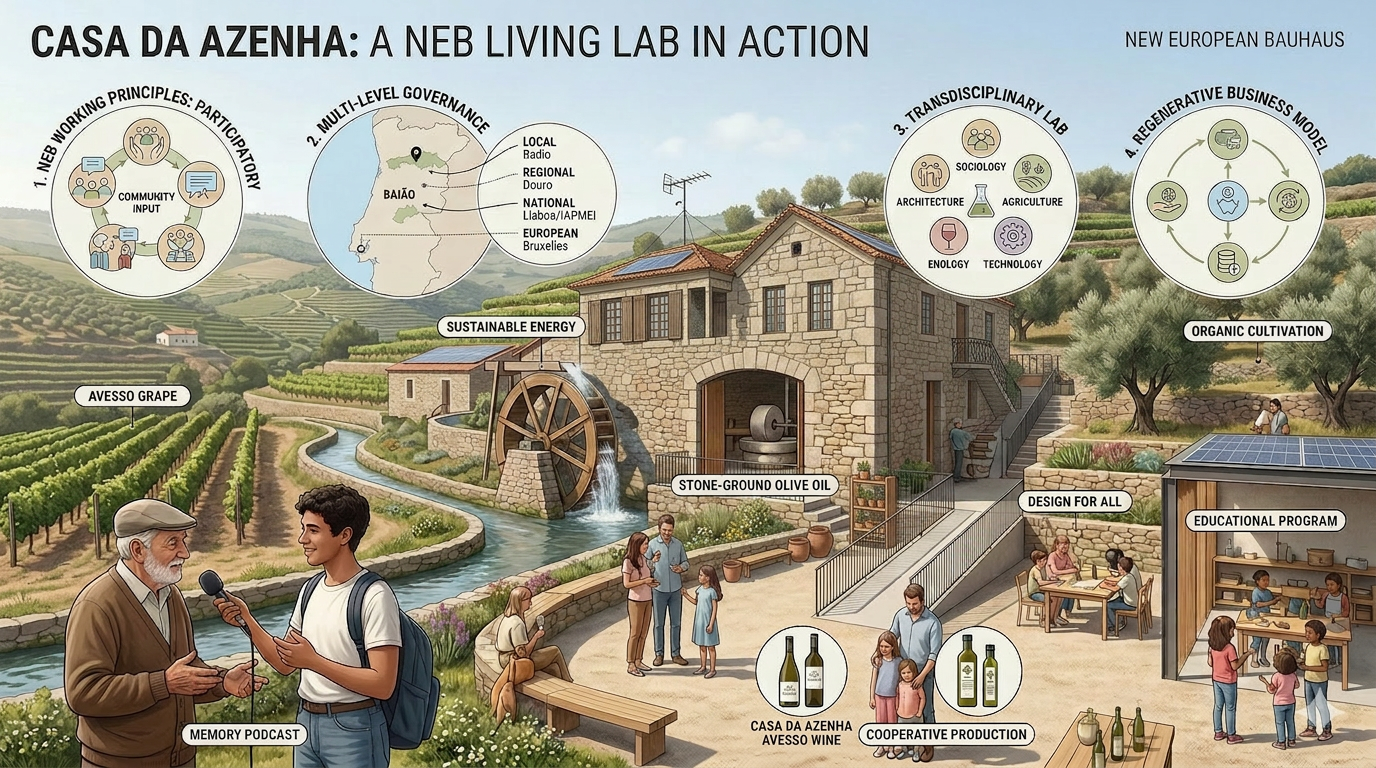
Casa da Azenha, located in Santa Cruz do Douro in Baião, Portugal, is transforming a traditional family olive mill into a living laboratory for sustainable rural development. The project was recognised in the 2026 New European Bauhaus Rising Stars awards, in the category Arts, Culture, and Heritage as Drivers of Change.
The estate has remained in the same family for five generations. Once a local economic hub that produced olive oil and provided employment, the mill closed in 1999. Casa da Azenha now seeks to reactivate this heritage by connecting traditional knowledge with social innovation, local production and sustainable tourism.
Rather than preserving the site as a static historical monument, the project aims to bring it back into everyday use.
Adaptive Reuse and Living Heritage
The project explores how a historic rural property can become a place for learning, production and community exchange. Its approach connects the preservation of buildings and traditions with new economic and social opportunities.
The former olive mill is envisioned as a living museum where visitors can encounter local history through activities, stories and relationships with the people who maintain these traditions.
This approach gives heritage a continuing role in community life. It also demonstrates how the adaptive reuse of existing rural buildings can support cultural continuity while reducing the need to replace historic structures.
Supporting Local Producers and Traditional Knowledge
Casa da Azenha places local production at the centre of its proposed model. Plans include reactivating olive oil production through a cooperative approach, developing small-scale wine production using the Avesso grape, and creating sustainable enotourism experiences.
These activities are intended to strengthen local value chains and create opportunities for producers. By connecting agricultural practices with visitor experiences, the project seeks to make rural knowledge and traditions economically viable for future generations.
Cultural programming and intergenerational knowledge exchange are also part of the vision, helping preserve oral histories and skills that might otherwise disappear.
Sustainable Tourism Rooted in Place
The project approaches tourism as an opportunity to support the local community rather than simply attract visitors. Experiences are designed around local products, family history, traditional practices and the cultural landscape of the Douro region.
Digital tools, including a proposed use of augmented reality, may help document and share local memories while keeping personal stories and lived experiences at the centre.
This balance between innovation and authenticity is central to the project’s ambition: using new approaches to sustain rural heritage without disconnecting it from the people who created it.
A New Future for Rural Communities
Casa da Azenha responds to wider challenges facing rural areas, including population decline, ageing communities and the loss of traditional knowledge. Its proposed cooperative model connects cultural preservation with production, employment and community participation.
Recognition through the 2026 New European Bauhaus Rising Stars awards highlights the potential of young initiatives that combine heritage, sustainability and social innovation.
For architects, designers and cultural practitioners, Casa da Azenha offers an example of how an inherited rural site can become a platform for renewal. Its vision suggests that sustainable development can begin by rediscovering the value of existing buildings, local skills and collective memory.